Enterprise AI Solutions

Blog

INDX experts share the latest AI technology trends, data utilization best practices, and practical knowledge to help enterprises advance their digital transformation.

On-Premises Deployment
3-Month Implementation
Enterprise Security
【The Next-Gen Auth Engine】 Bringing Google’s Wisdom to the World: How OpenFGA is Redefining Access Control
tech

【The Next-Gen Auth Engine】 Bringing Google’s Wisdom to the World: How OpenFGA is Redefining Access Control

OpenFGA is an open-source authorization engine inspired by Google's "Zanzibar" system. It shifts beyond traditional Role-Based Access Control (RBAC) to Relationship-Based Access Control (ReBAC), allowing systems to process complex permissions—like "team members of an owner"—at a blistering speed of under 50ms. While it requires sophisticated logic design and synchronization strategies, OpenFGA offers a scalable and reliable backbone for modern applications, setting a new global standard for handling intricate user permissions in a privacy-first world.

Nijino Matsumoto /松本 虹乃
5 min
What is Metadata? Meaning, Examples, and Its Importance in Business and Privacy
tech

What is Metadata? Meaning, Examples, and Its Importance in Business and Privacy

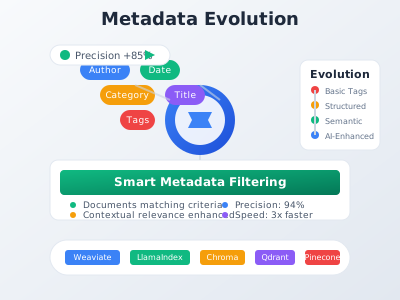
Metadata is defined as "data about data," acting as supplementary information—like a book's title or a photo’s GPS coordinates—that explains the core content. This article explores how metadata serves as essential infrastructure for digital organization and high-precision recommendation engines in business. It also highlights critical privacy risks, such as "re-identification," where combined metadata can pinpoint individuals even from anonymous datasets. Ultimately, the piece emphasizes that managing "attributes" is just as vital as managing "content" in our data-driven society.

Nijino Matsumoto /松本 虹乃
5 min
Practical Implementation of LLM Structured Outputs
tech

Practical Implementation of LLM Structured Outputs

This article explores "Structured Outputs," a critical component for transitioning Large Language Model (LLM) applications from experimental demos to robust production environments. We analyze how the latest native features from providers like OpenAI and Anthropic overcome the limitations of traditional prompt engineering to achieve 100% schema compliance. The discussion covers type-safe implementation patterns (Pydantic/Zod), advanced error handling, and best practices for workflow automation through "Data Structuring"—a core philosophy at INDX. This is a comprehensive guide for 2026 on how to build reliable, enterprise-grade AI systems that integrate seamlessly with existing software infrastructures.

Nijino Matsumoto /松本 虹乃
5 min